Is Gamestop Overvalued? – The Future

Now that we’ve discussed the business, potential problems, and historical financial performance of Gamestop, we can attempt to predict the future to determine if the stock is under-, over-, or correctly valued in the stock market.

Below is the second half of the DCF Excel spreadsheet with the future projections for Gamestop’s financials and projected Free Cash Flow, followed by an explanation of how these numbers were found.

GME Future

Future Sales: In your typical DCF model, you can just grow sales every year into the future using the average growth rate I list in cell G3 in the above spreadsheet. In reality, business rarely have revenue every year change by the same amount. Specifically with Gamestop, I chose to have temporary high growth in the near future because of all the new video game consoles being released in 2013 and the pent up videogame demand saved up for this occasion. However, for all the reasons listed in my “Supporting Arguments”, I decrease the company’s revenue in the future. For the specific percentages, I used Gamestop’s best and worst annual growth rates in the past five years.

Cost of Revenue and SG&A Projections: To find Gamestop’s future Earnings Before Taxes, Interest, Depreciation and Amortization, we need to subtract out its future Cost of Revenue and SG&A costs. To predict those costs, at the bottom of the spreadsheet I have included some extra information: The Cost of Revenue growth rate taken from the CAGR column and SG&A as a percentage of Revenue. SG&A as a percentage of Revenue is based on the average ratio of SG&A to Revenue from past years and using that average ratio in the future.

GME Other Variables and Ratios

Depreciation and Amortization: Future D&A was set at 2% of future revenue. This is another standard number that you could try and modify if you see major changes in these expenses, but I did not see such reasons. If you compare the future projections of D&A using this “2% of future revenue metric”, you will see it is relatively close to the past values and thus seems like a reasonable assumption.

Capital Expenditures: Future Capex was set at 1.85% of future revenue, which was the average Capex over the previous five years.

Increase in Net Working Capital: This is the most complex part of the Free Cash Flow equation, so I have dedicated a separate post to explaining the details on how to project future changes in Net Working Capital.

The equation for Free Cash Flow is:

EBIAT
+ D&A
– Capex
– Increase in Net Working Capital
=Free Cash Flow.

The reason this works to find the company’s available cash flow:

EBIAT represents the company’s earnings that could be used to pay off any debts in the event of a liquidation (hence why “Interest” is not taken out, interest comes from those debts).

Capex is subtracted because it is a use of the company’s cash. Even though it can be considered cash spent wisely to improve the business, it is still less cash available to the owners (the stock holders).

The Increase in Net Working Capital is subtracted because an increase in NWC, like Capex, means cash has been used to either increase the company’s assets or decrease its liabilities. Both of these are not strictly good nor bad, but they are uses of cash that are not available for the investors to pocket.

However, the remaining cash is available for investors.

Using the steps and descriptions above for each row in the Excel spreadsheet model and every column representing the next five year’s of the company’s operations, we can use the simple math explained above and in the past to estimate future Free Cash Flow.

With our guesses for the company’s future profits, we can now determine what the stock price should be.

Next: The Future
Previous: Net Working Capital

Is Gamestop Overvalued? – Net Working Capital

Increase in Net Working Capital: Increase in Net Working Capital is the most complicated of our future projections. This is because to properly find future NWC, you have to predict future Current Assets and future Current Liabilities.

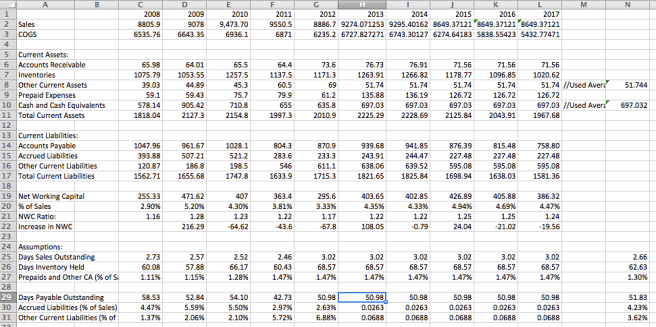
To accomplish this, I added a “NWC” spreadsheet to my Excel workbook:

GME Net Working Capital

All of the numbers in the 2008 through 2012 columns were taken from the 2008 through 2012 Gamestop Balance Sheets. The projections for the 2013-2017 values are found by taking the average growth rates or most recent value for the assets and liabilities and using those values or rates in future years.

The spreadsheet provides a visual for what makes up Current Assets and Current Liabilities. In English, they are:

Current Assets:

Accounts Receivables: Amounts owed to the company for products or services it has given on credit to other business or individuals.

Inventories: Inventories are the company’s raw materials and products made or in the process of being made.

Prepaid Expenses: These are expenses paid by the company before receiving the products or services for which it has paid. An example of a prepaid expense is an insurance premium which is paid completely upfront but covers a company or person for some amount of time such as a year. The insurance is a prepaid expense which initially is an asset that will get used over the course of the year, decreasing the asset over that time.

Cash and Cash Equivalents: The company’s cash and assets that can almost immediately be turned into cash, such as commercial paper and Treasury Bills.

Other Current Assets: Assets that do not fall into the above categories but are still assets that can be turned into cash within a year. These kinds of assets are typically non-recurring or not large enough to require their own category on the balance sheet. Some examples of this could be cash paid in advance to suppliers or employees that is accounted separately from the rest of the company’s cash or small investments in other companies or assets the company has made.

Current Liabilities:

Accounts Payable: Payments owed to the company for products or services already provided to a customer. This can be thought of in non-accounting terms as customers’ unpaid bills.

Accrued Liabilities: Expenses such as salaries, rent, interest, and taxes that the company owes but has not yet paid.

Other Current Liabilities: Other types of liabilities that don’t fit into one of the other categories, possibly don’t occur very often, and are due to be paid or worked off within a year.

Assumptions:

Day Sales Outstanding (DSO): DSO tells you how a company is managing its Account Receivables. The lower the number, the faster the company is getting paid by its customers. The equation for DSO is: (AR/Sales) * 365.

Days Inventory Held (DHI): DHI tells you how a company is managing its Inventory. The lower the number, the faster the company is selling or getting rid of its old product inventory. The equation for DHI is: (Inventory/Cost of Revenue) * 365.

Prepaids and Other Current Assets as a Percentage of Sales: This percentage is used to project the Prepaid and Other Current Assets into the future by setting them to a percentage of the future Revenue.

Days Payable Outstanding (DPO): DPO tells you how long it takes a company to pay its suppliers. The larger this number, the longer amount of time the company is taking to pay its suppliers. A larger number is good because it means the company is not rushed to pay its bills and has time to invest its cash into other parts of the business before having to pay bills. The equation for DPO is: (Accounts Payable/Cost of Revenue) * 365.

Accrued Liabilities as as Percentage of Sales: This percentage is used to project the Accrued Liabilities into the future by setting them to a percentage of the future Revenue.

Other Current Liabilities as a Percentage of Sales: This percentage is used to project the Other Current Liabilities as a percentage of the future Revenue.

Is Gamestop Overvalued? – Starting the DCF Model

Now that we’ve highlighted the important vocabulary used in Discounted Cash Flow modeling, we can build a model for Gamestop.

The goal of the DCF is to find the value of the company based on its future profit discounted at some rate to factor in the uncertainty of those profits. This “value” is called “intrinsic value”, which is different from the “market value” of the company. In the marketplace, anyone can buy the company or its stock for whatever someone is willing to sell to them at a “market price”. This can be unrelated to how much money the business actually makes.

The key points to remember are that although the market value can be unrelated to the health of a business, it can be easily seen in the market. The intrinsic value is how much a company is actually worth based on how much money it will make, but predicting the future is harder to see.

Given the information that companies are required by law to publish about themselves (the accounting statements in SEC filings), how can we divine the intrinsic value of a company?

This is done by taking the company’s revenues and removing all of the expenses that affect its cash until you are left with the Free Cash Flow. Finding how much cash a company makes is vital to its intrinsic value.

To get the actual numbers to plug into the DCF, we pull from the publicly published accounting statements.

In arithmetical terms along with the accounting statements where the data can be found, the DCF formula is:

Revenue (*Income Statement*)
-Cost of Revenue (*Income Statement*)
=Gross Profit
-SG&A (*Income Statement*)
=EBITDA
-D&A (*Income Statement*)
=EBIT
-Taxes (*Your Choice or Income Statement*)
=EBIAT
+D&A (*Income Statement*)
-Capex (*Cash Flow Statement*)
-Increase in NWC (*Balance Sheet*)
=Free Cash Flow

The DCF model is generally built using annual data, so taking these data points from one year’s SEC filings will give you one year’s Free Cash Flow.

But the company’s intrinsic value isn’t really determined by what happened in the past! What we want to know is how a business will do in the future after we’ve invested our money. As I pointed out in the introduction, we obviously don’t know the future, so the best we can do is use past performance, along with our educated guesses (hence the thesis and researched supporting arguments), to predict the future.

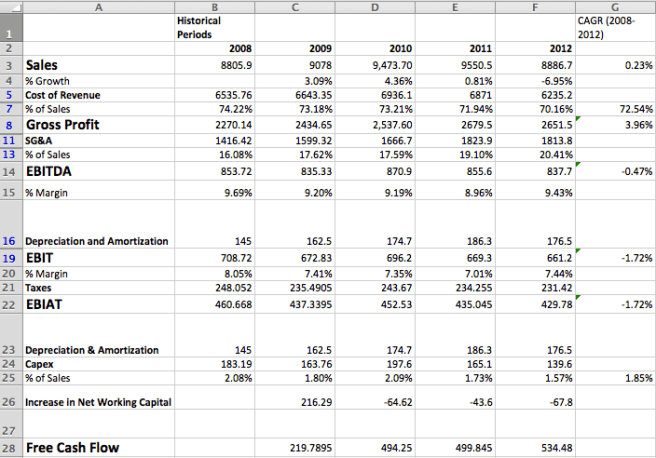
In a typical DCF model, you will want to run the above Free Cash Flow formula on multiple previous years, taking your data from those years’ publicly available financial paperwork. I have done this for Gamestop using the years 2008-2012 (the numbers are measured in millions):

GME DCF Past Data

Some things to point out from this historical data:

  • While revenue growth between 2008 to 2012 was almost flat (rising until 2011 then falling dramatically in 2012, possibly due to consumers waiting for the new gaming systems), SG&A expenses rose by $400 million over this period.
  • EBIAT has decreased from 2008 to 2012.
  • Capital Expenditures decreased from 2008 to 2012, which helped free up cash for the shareholders but could also signal decreased investment back into the business.
  • Despite the increase in SG&A and flat Earnings metrics, Free Cash Flow has more than doubled over the past five years, a good sign for stockholders.

On the far right I have included a column with the Compound Annual Growth Rate (CAGR) of the various financial data to show how these parts of the Gamestop business have grown over the past five years. We can use these growth rates to attempt to predict into the future, along with our own modifications based on our beliefs in the future of the business.

Next: Net Working Capital
Previous: DCF Glossary

Is Gamestop Overvalued? – DCF Glossary

Before walking through the model, here is a glossary of common accounting and finance terms that will be used throughout this blog series:

Sales/Revenue: Sales or Revenue is the total dollar amount a company has “realized” (received) through the sales of its products and services during a given time period.

Cost of Goods Sold/Cost of Revenue: These are the costs directly associated with producing the company’s products or services, which include the cost of materials used and the labor of making the product or doing the service.

Gross Profit: The profit earned by a company after subtracting the costs directly related to producing its products or services. This can be used as an indicator of the company’s efficiency and for determining gross profit margins.

Selling, General, and Administrative Expenses: These are expenses a company incurs that are required to run the business but not to directly make an individual product or service. Basic examples of this are building rents, utilities, and administrative and sales employee salaries.

Earnings Before Interest, Taxes, Depreciation, and Amortization (EBITDA): A common metric for operating cash flow since it reflects the company’s total cash operating costs for producing its products or services. It is also important for comparing companies in the same industry against each other because EBITDA is free from the differences companies have in the “capital structure” (whether a company is funded by stock investment or debt, and the interest expenses that come with debt) or tax rates. If this is not given by the company, it is calculated by taking the company’s reported “EBIT” number and adding back in Depreciation and Amortization. These are added because they are not cash expenses (cash was spent at some point in time, but not on a continuing basis). This is a non-Generally Accepted Accounting Principle measure, but is commonly used by companies and financial analysts.

Depreciation and Amortization: These are two methods for decreasing the value of an asset because it has been partially used. The layperson example of depreciation is of an individual’s car losing value after buying and driving it because the car has been used and is therefore older and potentially more “worn down”. Companies have assets which they depreciate in a similar manner. Amortization is reducing the value of an “intangible asset”. An layperson’s example of this is an “amortizing home loan”, where the loan’s principal value decreases steadily with each mortgage payment. While the house might be an asset, the loan is what is being paid, and financial instruments like loans can be considered “intangible”.

Earnings Before Interest and Taxes (EBIT, also known as Operating Income, Operating Profit, or Operating Earnings): The reason EBIT is also called Operating Income because it is the measure of a company’s profit after all its operational expenses (the SG&A, Depreciation, Amortization, and Cost of Goods Sold) that are part of earning its revenue are subtracted from its revenue. The only expenses left are interest on debt and taxes, which do not directly affect the business’s operations except as final expenses.

Taxes: The taxes applied on a company’s earnings. Typically for basic modeling purposes analysts will use 35% to 45% tax rates, but companies will give more detailed tax expenses or credits in their public filings.

Earnings Before Interest After Taxes (EBIAT): Earnings after taxes is sometimes used as a metric for comparing companies, but less so compared to EBITDA. Taxes are taken out because they are an expense that company’s have little influence on compared to the rest of their business and so are considered not highly relevant when trying to figure out how healthy a business is.

Capital Expenditures (CAPEX): A capital expenditure is an expense used to acquire or improve a company’s assets, such as building new factories and buying equipment. These expenses are made with the intent of growing the business. This is found in a company’s Cash Flow statement.

Current Assets: Current Assets are non-cash assets that can be used or turned into cash within a year, such as Accounts Receivable (payments due from customers to the company) and Inventory. This is found on the Balance Sheet.

Current Liabilities: Current Liabilities are liabilities that need to be paid or settled within a year. This is found on the Balance Sheet.

Net Working Capital (NWC): This is a company’s “Current Assets” minus “Current Liabilities”. This shows how much cash and other liquid assets a company uses to run its operations. One important point is that an increase in NWC is a use of or decrease in available cash because the cash is being turned into assets like inventory used to grow the business. A decrease in NWC is either caused by assets being used up to generate cash or liabilities decreasing, and is therefore an increase or source of cash.

Free Cash Flow (FCF): This is the cash left over after all the expenses of running the business have been removed from revenues. Free Cash Flow is what companies use to grow the business, save for a rainy day, or give money back to shareholders.

Weighted Average Cost of Capital (WACC): Companies are funded by some mix of equity (stock ownership) and debt. Investors who either buy the stock or give the company loans expect some return on their investment. The “cost of capital” is financial jargon for an investor’s expected return. Because stock and debt are have different legal and financial arrangements between the company and investors, they have different costs. A lot of public companies use a combination of stock and debt, so you have to find an average between the cost of stock and the cost of debt to the company. The equation for the Weighted Average Cost of Capital is:

WACC Equation

Where:
Re = cost of equity
Rd = cost of debt
E = market value of the firm’s equity
D = market value of the firm’s debt
V = E + D
T = corporate tax rate

Tangible Book Value (Per Share) (TBV): Tangible Book Value is the value of the company if it had to sell off all its tangible assets at the value of those assets in its accounting books. “Intangible” assets like trademarks and brand recognition are not included because, in a situation like bankruptcy where a company has to sell all its assets, intangible assets would have no or unpredictable value. If a company supplies its TBV data (which they typically do), it will appear on the Balance Sheet. TBV per share is the company’s TBV divided by the number of shares of stock, telling each shareholder how much of the company’s value his stock is worth.

Terminal Value: The value of the company as an ongoing business. In the context of a DCF model, it’s the value of all the potential future profits outside of the immediate years in your model.

Perpetuity Growth Rate: The annual rate at which the company’s terminal value will grow indefinitely into the future. This is a way to factor into your model the expectation that the company will continue to grow and this growth should be considered when valuing the business. This percentage is rarely more than 3% per year, which is the target for annual growth of the USA economy as a whole.

Enterprise Value: The value for the entire company. The equation for Enterprise Value is: Value of all the common stock (called “market capitalization”) + value of preferred stock (often given to special investors or founders/managers of a company) + value of debts + Minority Interests in Other Business – Cash and cash-like assets.

Next: Starting the DCF Model
Previous: Supporting Arguments

Is Gamestop Overvalued? – Supporting Arguments

Consumer Confidence Will Hurt Future Sales and Projections:

The beginning of a new videogame console hardware cycle impacts Gamestop not just in the sale of new hardware (where Gamestop’s gross profit margin is 7.6%), but starting another generation of game software that will fulfill future demand. The last console cycle started in 2005 with the Xbox 360 launch and in 2006 with the Nintendo Wii and Sony Playstation 3 launches.

The “next generation” of videogame consoles began November 18, 2012 with the Nintendo Wii U and will continue in Fall 2013 with the releases of the Xbox One and Sony Playstation 4.

I argue that much of the financial success of the previous videogame consoles and Gamestop can be attributed to a broader economic conditions from 2005-­2008.

Using the Consumer Confidence Index, the last console cycle which launched in 2005­-2006 began near the height of consumer confidence and spending in recent history. It’s very possible that the new Playstation 4 and Xbox One will not sell as well as the Playstation 3 and Xbox 360 due to the change in economic climate. The poor performance of the new Wii U discussed later supports this theory.

Consumer Confidence Index

The Conference Board Consumer Confidence Index®

Is it possible that consumer confidence will either increase in the future in the middle of the console cycle or that spending on games won’t be correlated to consumer confidence? It is possible, but I suspect unlikely. Academic research has found a moderate connection between the consumer confidence numbers and consumer spending in the following quarter. [Ludvigson, Sydney, 2004, Journal of Economic Perspectives].

Gamestop’s same­ store sales the past five years are in line with a decrease in consumer spending. From page 29 of the 10K, same ­store sales growth has been:

2012: ­-8%
2011: -­2.1%
2010: 1.1%
2009: ­-7.9%
2008: 12.3%

A historical look at the Nintendo Wii’s sales through 2008 would show huge sales growth despite the broader economic conditions, but Wii sales began to slide in 2009 and continued until the present day. All three systems saw sales rise during the typical cyclical holiday seasons in 2007 and 2008, but the systems with the largest sales increases were the cheapest, with the PS3 lagging due to its higher price at the time. These were systems which had already been on the market for two to three years with a library of games for sale.

Poor Wii U Sales:

The Wii U has been a disappointment since it launched on November 18, 2012. As of March 31, 2013, only 3.45 million units had been sold, well short of its originally estimated 5.5 million. At the E3 industry conference last week, only three new Wii U exclusive titles were announced.

A comparison between the second months of the Wii and Wii U shows the stark contrast in the current and likely future performance of the Wii U. In January 2007, the Wii’s second month, the Wii sold 425,000 units. In January 2013, the Wii U’s second month, the system sold 57,000 units, 13% of the number of Wii units sold at the same early point in the system’s launch near the end of a holiday season.

Fewer consoles sold likely means less software sold. Less new software sold means fewer used games down the line. Nintendo announced in May 2013 that it had missed its profit goals by nearly 50%.

Whether the lackluster Wii U sales are due to lower consumer spending in general or mismanagement by Nintendo, lower hardware sales will translate into lower software sales for Gamestop. This should give pause to investors expecting that the other console launches later this year will be guaranteed successes.

Game Streaming Plans In Motion:

Sony and Microsoft have both made investments into technology for streaming games over the internet. Once game streaming becomes mainstream and gamers can access games over the internet on demand, this will have a negative impact on disc­-based game sales.

In late 2012, Microsoft hired a number of employees from the bankrupt OnLive game streaming technology company.

At the E3 convention, Sony confirmed that it will launch a game streaming service in 2014, starting with older games that are commonly sold as used games at Gamestop stores. This technology comes from its acquisition of Gaikai earlier this year.

Microsoft and Sony are both moving toward implementing these game streaming technologies in some capacity, cutting out retailer middlemen between them and game consumers. This allows potentially lower prices for gamers and a bigger cut of the sales for the console manufacturers and game publishers/developers. For these reasons, the streaming alternatives will be compelling for all parties and only detrimental to the retailers such as Gamestop.

Gamestop acquired Spawn Labs in early 2011 to develop its own game streaming offering. Since the acquisition two years ago, the only news to come from it appeared in the Fiscal 2012 10K: “Spawn Labs is developing a streaming service which the Company may deploy in fiscal 2013 depending on consumer demand and other factors.” It claimed a year ago that it would have a beta test of its system in homes across the country. The latest 10K in May had no updates on this.

With Sony and Microsoft having a direct connection to living rooms with its hardware and technology further along than Gamestop’s, it is hard to see where Gamestop’s Spawn Labs product can get a foothold in the game streaming marketplace.

Gamestop is a Late, Minor Player in Digital Downloading:

The leader in digital game downloads is Valve’s Steam store, which in 2010 had an estimated almost $1 billion in revenue and $300­$400 million in profit for Valve. Steam holds approximately 70% of the digital download market, compared to Gamestop’s Impulse service’s 10%.

In its filings, Gamestop claims $630 million of “digital receipts” in fiscal 2012. This number is deceptive because it includes the in­-store sales of “DLC” cards, which are “downloadable content” points for Microsoft and Sony network stores. While this business has 38% gross profit margins, these points can be bought in numerous places and directly from Microsoft and Sony. By grouping the Impulse store sales with these DLC cards into an “Other” and “Digital Receipts” category, Gamestop is able to gloss over the underperformance of Impulse. The fiscal 2012 10K states the above $630 million in “digital receipts” but $593.4 million in “Other” in­-store sales, a category including the brick-­and­-mortar digital content sales. The $36.6 million gap is possibly attributable to Impulse sales (this is not made clear in the 10K). Assuming Gamestop’s cut of the store revenue is similar to Steam, then Gamestop’s gross profit from Impulse is approximately $10 million to $15 million, an almost insignificant amount compared to its $2.651 billion in annual gross profit.

Competition from big box and online retailers:

This argument is straightforward: Gamestop does not offer much that other retail stores do not. Wedbush Morgan analyst Michael Pachter has stated that, based on the previous hardware cycles, “It appears that once hardware supply was sufficient to satisfy demand, gift givers tended to purchase hardware when it was convenient, causing a market share shift from destination specialty retailers in favor of more frequently visited mass merchants,” said Pachter. In other words, Gamestop will play a significant role this Fall in selling new console hardware, but over the hardware lifecycle, Wal­Mart and Target reach more consumers.

Amazon has already sold-­out its allotment of pre­-orders for the Xbox One and Playstation 4. The advantages of Amazon as a retailer for most physical goods, including videogames, is well-­known, especially around ordering and shipping convenience and product availability.

Over-­reliance on Pre-­Owned Software:

A lot has been written on how Gamestop’s business is driven by used game sales. In the latest 10K for Fiscal 2012, Gamestop showed that 44% of its Gross Profit comes from pre-­owned game and hardware sales, which have 48% margins. All of the previously listed threats to its business would ultimately hurt the availability of used games.

A great breakdown of the problems Gamestop will face if its pre­-owned business suffers was done by Gamasutra writer Matt Matthews:

“In terms of New Software, as GameStop has repeatedly noted, customers put $7 out of every $10 in trade value back into new game purchases. If the margin on pre-­owned software is reduced, then GameStop could respond by offering less trade value to consumers ­­ and that would reduce the available trade credit to go toward new games. Therefore when consumers are trading less in at GameStop, publishers can expect to see retail sales of their new games go down as well.

Alternatively, if GameStop continues to offer aggressive trade­-in values, it can still retain some of its pre­-owned product margins by raising the price it charges the consumers who then buy those pre-­owned games. However, raising its selling prices would make GameStop’s pre-­owned products less attractive to consumers, and decreasing the net sales in its Pre­-owned Product segment.

Even GameStop’s Other segment, where it puts its digital revenue, could be harmed by a change in its pre-­owned business. GameStop has been at the front line of attaching DLC purchases to games sales, both new and used. If either new or used software sales decline at retail, it is quite likely that retail DLC sales will go down as well. Consequently, harming GameStop’s pre-­owned segment also diminishes its digital business.“

Next: Discounted Cash Flow Vocabulary
Previous: Introduction and Thesis

Is Gamestop Overvalued? – Introduction and Thesis

Note: This blog series describes an investment idea in retrospect that was analyzed and predicted months ago.

As evidence that the research and pick was made in June 2013, I directly reference those that saw this analysis last year.

Bill Babeaux – Instacart
Adam Millat – Millat Industries
Andrew Virata, Marisa Mulac- JPMC
Kateryna Parke – Houlihan Lokey
Mintai Wang – Factset
Nate Palmer – Diamond Hill Capital

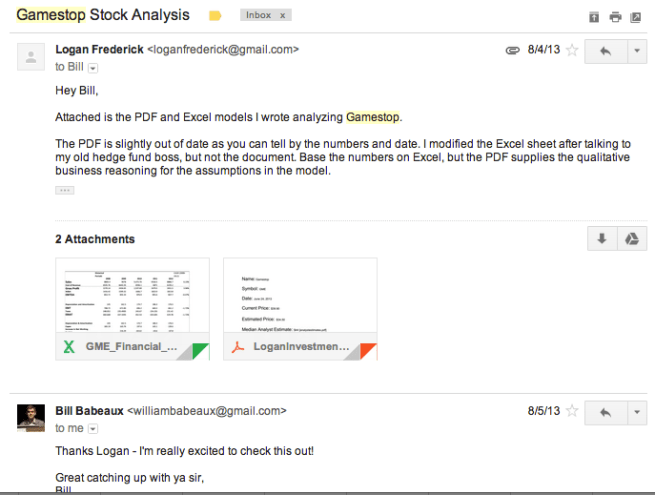
If someone had shorted Gamestop as this research suggests from the date in the email below to Bill (August 4, 2013) to today, they would have earned 25.28% compared to the S&P 500 return of 7.55%.

Email Evidence with Bill Babeaux for Gamestop

After talking to some of these individuals about the stock’s tanking the past few weeks, I have decided to turn this research into a series of blogs.

As an employee of JPMorgan’s Investment Bank, our trading and social media presence is supposedly limited. However, since I am not on the side of the business that would deal with Gamestop’s stock and the move has already occurred, I feel that blogging my research is worthwhile.

These guides are meant to be informative so you can use them to learn finance and value companies yourself. Stocks are constantly moving. Although I believe Gamestop still has further to drop, the analysis presented here is already somewhat out of date.

Last note: The research is also available for download.

An Introduction to Discounted Cash Flow Analysis:

How do I know if a stock price is too high or too low? How do I know what to buy and sell? These are the basic questions most people ask about stocks. My goal is for this blog series to give my readers a glimpse into the techniques investment bankers and professional investors use to answer them.

A lot of people have heard of “financial models”, but have no understanding on what the term means. While there are numerous meanings for the phrase, most models involve using pre-existing information, putting the information into a formula, and the formula will give you the answer to your question. If, as a layman, it sounds intimidating, don’t fear; it’s mostly arithmetic.

The one particular model we will learn about is a system for taking information about a company with publicly available stock and how to determine the value of the stock: Discounted Cash Flow Analysis.

Discounted Cash Flow (DCF) analysis is predicated on one core idea: A company’s value is determined by how much cash it will make for the foreseeable future. Hence “Cash Flow analysis”. The “Discounted” word means that cash the company earns in the future is worth less than cash they earn today because the future is unknown and risky, so we “discount” future cash. This principle is called the Time Value of Money.

The next question: How do we know how much cash a company earns? This question and answer should be split into two parts: First, how do we know how much cash a company has earned in the past, and second, in the future?

Answer one is that every company with stock that is “publicly traded” (available for anyone to buy) must file publish their accounting statements with the Federal government’s Securities and Exchange Commission, the agency responsible for enforcing legislation regarding financial markets. Often companies publish these reports on their websites as well (our example company, Gamestop, maintains a website for investors). Companies have to release their financial information by law so that individuals such as ourselves and professional investors can make the very investing decisions we will make in this essay.

However, since we obviously do not know how much money they will make in the future, we have to do some predictions. This is when we can use the DCF model.

To demonstrate the use of a DCF model, I will analyze a stock I believe to be overvalued: Gamestop, the video game retail store.

Stock Price Predictions:

“Current” Stock Price (as of August 4, 2013 when analysis was finalized):

$50.29

Today’s Stock Price (February 4, 2014):

$33.83

My DCF Model Stock Price Valuation:

$23.78

Thesis:

Gamestop is the self-described world’s largest multi­channel videogame retailer. They sell new and pre­owned video game hardware, physical and digital video game software, accessories, as well as PC entertainment software, new and pre­owned mobile and consumer electronics products and other merchandise.

The original research was inspired by the idea that what had happened to movie, music, and book retailers would happen to videogame retailing as well, specifically the loss of sales to big box and online retailers with broader reach in terms of marketing and logistics, improving game streaming technologies supported by the console makers, and the digital distribution of games.

The results of the research show that Gamestop is overvalued. The management has a strong retail background and has paid down all of the company’s debts, but little to no technology expertise. Despite a large cash reserve saved from boom years and still strong free cash flow, management has elected to return this cash flow to shareholders via stock buybacks and dividends. This is a move I disagree with, as it signals to me the company is not investing enough on addressing the long term trends that will, but have not yet, devastated its core retailing business.

Next: Supporting Arguments

Is Gamestop Overvalued? – An Applied Primer on Discounted Cash Flow Analysis

This is the Table of Contents for my blog post series “Is Gamestop Overvalued? An Applied Primer on Discounted Cash Flow Analysis” where I walk through how to value the stock price of a public company based on its publicly-available accounting statements.

  1. Introduction and Thesis
  2. Supporting Arguments
  3. Discounted Cash Flow Vocabulary
  4. Starting the DCF Model
  5. Net Working Capital
  6. The Future
  7. Valuing the Stock
  8. Extending the Research
  9. Conclusion

Is California's Budget Endangering Silicon Valley?

Meredith Whitney isn’t well-known in the technology community, but she’s made a name for herself in the financial world. I personally first learned her name from Michael Lewis’s fantastic book The Big Short. Lewis, along with most of Wall Street, was struck by Whitney’s foresight when, on October 31, 2007, she announced that Citigroup’s dividend payments exceeded its profits and would have to be eliminated. Four days later, Citigroup CEO Charles Prince resigned. Anyone interested in how Whitney rose to become one of Fortune’s “50 Most Powerful Women in Business” should read Lewis’s short biography of her on Bloomberg.

After slaying the banks in 2008, Whitney has come out decrying an even greater financially mismanaged beast: The coastal states. Her first, recently released book, The Fate of the States, uses research from the Meredith Whitney Advisory Group to reveal the terrible financial condition of these highly leveraged states. The primary target? California.

The Fundamental Problems: Debt and Pensions

California has about 12% of the total US population, but contributes 13% of GDP and generates $100 billion in annual state and municipal tax receipts. As if you needed more evidence, California is a big state in every sense of the word.

Sadly, Whitney is quick to point out that California made the same gamble on housing that banks and consumers did; the state bet that property tax revenues would never decline, and borrowed and spent money accordingly. It’s no surprise that the state has suffered the same consequences since 2008 as individuals and banks which bought into the housing market.

By 2011, the average Californian had consumer debts of $73,000 and $11,000 in tax-supported state obligations while only earning $43,000 in income. Since 2008, home prices in California have fallen almost 40 percent and nearly 30 percent of mortgages in the state are underwater. In the last decade, debt-per-capita increased 100% in California, 88% of this debt tied to real estate.

These debts and those held by the municipal governments cripple the ability for the state to function. As personal and governmental debt increases, at some point consumer spending and government services have to be cut to cover debt payments. This begins a negative feedback loop where private business growth slows or declines, tax revenues fall, the government must raise taxes to compensate, and economic growth drops further. It’s important to remember that the tax base is the revenue source for a city, state, or country. If citizens make less money and are given reason to leave, government revenues fall.

From 2008 through 2010, California’s tax receipts fell from $118 billion to $105 billion, with total state and local receipts dropping from $781 billion to $702 billion. In an attempt to compensate, California already raised income and sales taxes in 2011 and 2012.

One of the biggest debts many states, especially California, face are unfunded pension liabilities for retired and current public employees, particularly in the prison and education systems. In 2009, new Government Accounting Standards Board rules forced states to disclose unfunded pension and health-insurance obligations. What California unveiled when forced was not a pretty picture. From 2000 to 2010, state spending grew 72% to $107 billion annually. State government spending as a percentage of state GDP was 25.3%. Most horrifying, this spending outpaced the government’s revenues by 224% in 2009 and 92% in 2010, and increased by 50% in the past year. Over 20% of this spending (over $21 billion) goes toward state liabilities including general obligation debts, unfunded pensions, and other post-retirement benefits.

Pensions are particularly challenging for states to manage because they are given special legal protection or “seniority” over other liabilities and expenses. These, as part of pension contracts, can be enforced in court. The pecking order has pension obligations and municipal debt required to be paid before everyday expenses like education, police, roads, and public services. “The fight is not just political but constitutional too: Courts are now deciding whether municipalities can use ballot measures and bankruptcy laws to void or change public-employee pensions,” writes Whitney. “At the heart of the problem is a difficult truth: There’s not enough money to pay for everything, and by law, pension payments trump most other types of spending.”

Employees contribute little to their government pensions (generally less than 10% of the total contribution). The rest is covered by taxpaying citizens. At the same time, pensions are given embedded cost-of-living (COLAs) which are meant to buffer the pension funds against inflation, except they are not benchmarked to inflation. The average COLA is 3%, but average wage growth has been 2% in the past decade. The COLAs have effectively been pay hikes of 1% over the average for people who are not working.

Before breaking down the liabilities into greater detail, the problem for California is summed up by Whitney early in her book: “California allows a police chief to retire with a pension of over $200,000 after less than a year on the job but doesn’t have enough money to buy new books for classrooms or to keep violent felons in jail. No wonder the state is facing an exodus of employers and employees alike…. With not nearly enough money to go around, the impending war over public-employee pensions threatens to be one of the more vicious political debates this country has seen, pitting Americans against Americans, neighbor against neighbor.”

The Logical Question: How Will This Affect Silicon Valley?

The evidence for California’s impending financial apocalypse isn’t difficult to understand. Given the above numbers showing that, as a state, California owes and is spending more than it earns, the jig is going to have to be up at some point in the future. One could propose that California could try to maintain its spending-more-than-it-earns ways by continuing to borrow money from the federal government, international lenders, or bond markets, but as we’ll show, these cash sources have their own problems and can be wary of investing in something when it’s uncertain whether the state will be able to afford providing a return on the investment.

I am suggesting that, while California simultaneously looks at the above options for money and finds them increasingly unattractive or unavailable in the future, the state government will look to its best internal sources of money to cover its obligations. And California’s most notable and profitable sector is the technology industry in Silicon Valley. Connecting the dots from California’s financial woes to the money generated by the companies and cities in the Valley reveals the question: Are the companies and cities in Silicon Valley going to be asked or forced to assist the rest of the state financially so California doesn’t collapse around it? What form will this “help” take? New, higher taxes for the companies in the Valley? A decrease in federal funding for the municipal governments of San Francisco, Palo Alto, Cupertino, and Mountain View so the money can be used elsewhere?

Further Dissecting California’s Finances

Another problematic industry plaguing the state budget is prisons. In 2010, California spent $6 billion on 30,000 prison guards and other prison system employees. That year, the state’s highest paid employee was the head parole psychiatrist with a staggering $838,706 income. From a 2011 Wall Street Journal story, Californian prison guards could receive $85,000 per year in pensions when retiring at age 55. A 55 year old private sector worker would need $1.63 million in savings to purchase an annuity with similar yield. The insanity of this relationship is that private sector workers must save huge sums of money for their own retirements while covering the taxes that are used to pay for public worker pensions.

By comparison, in 2010 the state only spent $4.7 billion on higher education and has continually cut college funding. In the past 30 years, the state has sunk from being 30% of the University of California’s budget to 11%. In 1980, a Cal student spent $776 in tuition per year. This number was $13,218 in 2011. From 2004 to 2011 alone, university tuition in California rose 80%.

Kindergarten through 12th grade schooling accounts for 20% of state spending and colleges are another 10%. The second largest expense is Medicaid. Given California unemployment at 12%, the Medicaid budget has continued to grow and taking room from education spending. California has cut $6 billion in education spending since 2008. In 1990, California had a 1.3% lead over the USA average for the percentage of its population graduating high school. By 2008, it was 6% below the national average. Only 18% of those high school graduates enrolled in state colleges in 2012. In-state community college enrollment dropped from 2.9 to 2.4 million.

The two primary segments where the federal government gives financial aid to states is for Medicaid and food stamps. These two programs are meant to support for people living in poverty (defined as an annual income of $23,000 or less for a family of four). As of early 2013, the poverty rate in this country was 15%. It was 11% in 2000. One in seven (43 million) Americans live off food stamps. California spent $10 billion in fiscal 2010 on public assistance programs. In 2000, 7% of the California budget was spent on public assistance. While this was down to 4.9% in 2010, the number of unemployed who rely on these programs in the state increased by 2 million.

The results of these debts and the economy have already hit Californian cities. In the early 2000s, Lou Paulson, head of the Contra Costa County, California firefighter’s union, negotiated new contracts for its member which allowed them to retire at age 50 with an annual pension equal to 90% of their final salary for the rest of their life. This same city levied a new $75-per-year-per-home tax in November 2012 to support the current fire department which would otherwise need to close six fire stations due to lack of funds. The ballot failed. Kris Hunt, director of the Contra Costa Taxpayers Association, was outraged at firefighters for raising more taxes and posted online the name of every retired public employee with a pension above $100K. It had 665 names, 24 who exceeded $200,000 per year. 268 of the 665 were firefighters, while there were only 261 firefighters currently employed on the streets.

A local construction worker named Matt Heavy on NPR: “I felt hostage…either pay the extra money or we’re going to start shutting down stations. And the bottom line is the reason that they’re asking for the money is because the pensions are just skyrocketing.”

The Main Competition: Texas

I currently live in Illinois (another debt-burdened state) and interned for a summer in San Francisco, so I have little bias in telling this story. With all California’s financial problems laid bare, the next question is who is in position to take advantage of California’s decline? Whitney’s answer: Texas. Why? Because by a variety of economic metrics, Texas is a better state in which to live and work.

Over the past decade, the life prospects for the typical Californian have gotten significantly more precarious than the average Texan. The average debt-to-income per capita in California is 170 percent compared with Texas’s 80 percent. Since the housing crash, the percent of homes with negative equity has risen to 29 percent in California versus only 9 percent in Texas. In the early 2000s, California’s unemployment rate was 20% higher than the national average and 30% higher by 2010. “By 2010, the last year for which data is available, consumer debt per capita in California hit $74,950, a debt-to-income ratio of 174%. By comparison, the average debt per capita in Texas was $36,000, which translates to a debt-to-income ratio of 89%,” Whitney elaborates.

For an individual deciding where to live, Texas offers the obviously better bang-for-your-buck deal. Texas does not tax individual income. California voted to raise income-tax rates on those earning over $1 million to 13.3% (the highest state income-tax rate in the country) and 10.3% for those making over $250,000. Compared to Texas’s zero rate, that’s an extra $26,000 taken out of your pocket annually.

Along with no income tax, personal income was growing 73% faster annually by 2012 in Texas than in California, and the average home price is 60% lower.

From 2009 to 2010, 12% of people moving out of California moved to Texas, which is astonishing considering that the move is basically across half of the country. By 2012, the problem had piqued the interest of California’s legislature enough that it sent an economic research team to Texas to investigate the population drain. A total of 1.9 million Californians left between 2000 and 2009.

University of Michigan economic professor Mark Perry noted, “In April 2012 the cost of renting a U-Haul truck for a one-way trip from California to Texas was twice that from Texas to California. The price ratios suggest that demand for trucks leaving California is roughly double the demand for trucks coming into the Golden State.”

Whitney added, “The fact is that California’s total obligations – obligations that can be escaped by the simple act of moving – increased by 50 percent in one year alone…. Moving has become an easier decision for businesses too. Consider, for instance, a corporation headquartered in Silicon Valley. The average corporate tax rate in California is over 8.8 percent and the average sales tax is 7.25%. Sure, property taxes are kept in check by Proposition 13, but the cost of living is higher than in most other states and social services are vanishing….

“When a satellite operator like Globalstar moves from California to Louisiana or a food company like Chiquita relocates its headquarters from Ohio to North Carolina, the decision to move often boils down to taxes….

“By mid-2006 the real cost of homeownership in California was more than twice the national average. The ratio of average home price to per-capita income was 9.7 in California versus 4.2 for the United States nationally. The price-to-income ratio in Texas was a mere 2.6. Was it really worth over three and a half times more to live in California than in Texas?”

It’s not just individuals who are moving; companies are too. Major tech companies like Google, eBay, Amazon, Intel, and Apple have all added new offices and invested hundreds of millions in Texas, especially in the city of Austin. According to a study by Joseph Vranich, an expert in studying business relocations, the number of businesses leaving California increased fivefold between 2009 and 2011.

Whitney elaborates, “In 2012, when Apple was deciding where to invest $300 million and add 3,600 new sales and accounting jobs, it chose to build in Austin Texas, instead of near its Cupertino, California headquarters. When San Jose-based eBay and its PayPal subsidiary were looking to add 1,000 new jobs, eBay also chose Austin, Texas. Where jobs go, taxpayers follow: According to the Manhattan Institute for Policy Research, of the 1.1 million Californians who left the state in the 2000s, 225,000 of them moved to Texas, making it far and away the most popular destination for ex-Californians.”

She continues, “The smart money understands that taxes can only go up given the massive sums of bonded debt and unfunded pension and health care liabilities coming due in future years. Thanks to reckless fiscal mismanagement by cities and states, individuals and corporations still residing in those states will all be on the hook. The smart money also understands that with those higher taxes will come a lower level of public services- that the states in the deepest fiscal trouble have far fewer resources to invest in roads, bridges, airports, education, public safety, and all the other things relocating businesses look for in a new home…. No wonder smart money is flocking to states with lower tax burdens and less strained budgets. The dumb money is those left behind to pay high taxes for lesser services.”

Historical Precedents

California is no stranger to having individual cities collapse. The below examples are meant to drive home the point that if these continue, the state government will have to step in (and in some cases already has). If the state government has to continually bail out its bankrupt cities, it may have to take money from the successful cities to prop up the losers.

Orange County went bankrupt on December 6, 1994 when it was the sixth largest county in the country. County Treasurer Robert Citron had used derivative markets and high-yield bond investments to boost county revenues during the early 90s recession. When those trades lost $1.4 billion, the city had to declare the largest municipal bankruptcy in US history. When the muni bond markets responded by raising interest rates on all cities in California, it was cheaper for the state of California government to support an Orange County reemergence in 1996 than pay higher rates on government-issued bonds. One Orange County citizen stated, “I don’t know who will make up the deficit but I really don’t think it should be the citizens.”

In June 2012, Stockton, California became the new largest US city Chapter 9 bankruptcy. A city of only 292,000 residents saw home prices triple to an average of $400,000 from 2001 to 2006. The city officials assumed the area’s economic growth would continue indefinitely and increased its spending habits accordingly, going from $160 million in 2003 to $200 million in 2007. Stockton also had one of the worst pension agreements of any city. California state law requires public employees to contribute between 7-9% of their salary to their pension plans. The city of Stockton agreed to pay this contribution for its public employees! On top of these mounting expenses, Stockton borrowed $125 million through a city bond issue in 2007, only to invest that money in the stock market and lose $25 million of it. From 2006 to 2011, home prices in Stockton fell 58%. The city had to cut public services, slashing the police force by 25% and the fire department by 30%. Now it has the tenth highest rate of violent crime for all cities in the country. As of September, 2012, the city was embroiled in legal battles with two bond insurance companies attempting to force the city to suspend payments to its public employee pensions and redirect the funds to its bondholders. The city has spent at least $4.9 million on lawyers. Stockton City Manager Bob Deis was quoted saying, “We are trying to be responsible in dealing with our creditors, but in the process we cannot destroy a community and its hope for the future.”

Mammoth Lakes, California filed for Chapter 9 bankruptcy on July 12, 2012 after losing a $43 million lawsuit against Mammoth Lakes Land Acquisition for breaching a land development contract. This judgement was three times the small city’s annual budget, which was already $2.3 million in the red.

Two days earlier, San Bernardino filed for its own Chapter 9 bankruptcy. From 2008 to 2012, the city trimmed its public workforce by 20%, and yet the budget gap was still $46 million with another $157 million in unfunded pension and health-care obligations.

How did so many Californian cities get into so much trouble? San Jose mayor Chuck Reed speaks from experience, “Hell, I was here. I know how it started. It started in the 1990s with the Internet boom. We live near rich people, so we thought we were rich.” San Jose is under heavy financial stress. By 2015, San Jose pension costs are expected to be $400 million to $650 million. Once run by 7,450 public workers, the city is maintained by 5,400 employees. Remaining workers have taken a 10% pay cut from a couple years ago. Reed expects that his city of a million people, the 10th largest in the country, will be serviced by only 1,600 public employees in 2014.

What Can Be Done

Thus far we’ve established that the State of California and many of its municipalities are in great financial danger. The thesis of the essay is that these budget weaknesses may force the state to look at Silicon Valley as a source of extra income. But before this happens, are there any other options the state can pursue?

From Fiscal 2008 to 2012, states used the following measures to close their budget gaps (the differences between their large expenses and decreasing tax revenues) based on Bureau of Labor Statistics and MWAG research:

  • Spending Cuts: 45% of money used to close budget gaps
  • Federal Funding from the American Recovery and Reinvestment Act of 2009: 24%
  • Revenue Increases: 16%
  • “Rainy Day” Funds and Other Cash Reserves: 9%
  • Other (Date shifting, on-time/short-term borrowing): 7%

Sadly, Whitney adds, “There is no more money. There are no more stimulus dollars. There are no more rainy-day funds to raid. The emergency options have all been tapped.”

Pensions are huge expense. The state and cities need to renegotiate the pension contracts with public worker unions to decrease benefits owed and lighten the burden on current taxpayers. It’s important to remind ourselves going into these talks that no one is right or wrong and almost nobody at the table is to blame. Government employees were promised benefits and negotiated their contracts. Taxpayers pay taxes with the expectation of certain levels of services: Education for their children, safe streets, and running water. Municipal bondholders lent money to these cities expecting a return. The politicians currently in office are generally not the ones who got the cities into this mess.

Rhode Island provides a bright example of a state grappling its pension problems. In 2012, the state raised its the percentage of its pension liabilities funded from 48% to 60%, reducing its unfunded liability by $3 billion. This was accomplished with bipartisan support from government officials to negotiate concessions from the public employee unions on benefits and cost-of-living adjustments for current and future retirees.

Privatization is the government taking businesses it owns and selling them to private companies. Indiana Governor Mitch Daniels set a controversial precedent when, in 2011, he leased the state toll road for 75 years to private investors for an upfront payment of $3.8 billion. This and other privatizations like it raise cash for the government while losing its long-term revenue-generating assets. Opponents of privatization will ask: Why sell the income of tomorrow for cash today? The answer: Given the heavy debts states carry, they have to raise cash just to survive.

There is also a successful historical precedent for privatizations, particularly in Europe in the 1980s and 90s. To join the European Union, a nation’s deficit had to be under 3% of GDP. Many countries accomplished through selling assets. From 1990 to 2009, $1 trillion was raised by EU countries through these sales, $100 billion from privatizing transportation industries alone. By comparison, the United States government has planned and funded less than $20 billion in similar transportation projects. Given the lack of investment by the US government and states in transportation, a case could be made that infrastructure and transportation would be improved under companies that have a profit motive, rather than government politicians untrained in asset management.

Some parts of California have started to privatize their assets out of necessity. The state has outsourced operations for six of its public parks. The Brannan Island State Recreation Area, outsourced in 2012, used to cost the state $740,000 per year, twice its revenues from fees and concessions. These parks are being privatized either through profit-sharing between the state and the operators or outright sales for cash.

There are numerous other changes state governments need to make: Invest whatever cash they can into improved education and jobs programs, monetize their natural resources, and promote right-to-work laws (job growth in right-to-work states was double the non-right-to-work states from 1977 to 2008). These cost the states little and allow them to grow in the coming decades while using their current cash to cover their short term problems.

Unanswered Questions

While it’s clear that California is one of, if not the, worst managed state financially, what’s still unclear is what exactly this means for Silicon Valley. None of what I’ve presented definitively demonstrates that Silicon Valley will be crushed by California’s mounting debts. To truly answer the original question, we would need more research and answers to the following questions:

What is the political relationship between the local Silicon Valley governments and the state? How much can the San Francisco, Palo Alto, and Mountain View politicians keep their cities siloed from the rest of the state’s problems?

How will Berkeley and Stanford be affected by decreases in state funding? These universities have endowments. Will the be able to easily dip into these funds to continue their operations? Will they need to cut costs? What about the other California universities? The state has a reputation for being leading technology and business schools. Can the local schools continue to feed intelligent, high-income earning and job creating student? It’d be a shame if these programs suffered due to financial mismanagement higher in the food chain.

In the face of increased taxes and even higher standard of living costs, will technology entrepreneurs still gravitate to the Valley? Although Paul Graham’s essays on Startup Hubs and Professor Richard Florida’s “Clustering Force” explain why Silicon Valley has grown into the leading location for the technology industry, there must surely be some structural limit to the pull startup hubs have. Those structural limits are determined by the institutions of the location’s government. Things like regulations and taxes will impact how people perceive a city, and if taxes continue to rise, would-be entrepreneurs around the world will reconsider Silicon Valley when there are other fertile environments.

Despite California’s problems being financial, the solutions will be political. Who will bear the weight of these debts as they continue to be called? Who will volunteer to decrease their standard of living (fewer public services, increased crime, under-performing schools) so the greater system can continue?

I can imagine a defensive reaction from Silicon Valley residents. After all, they aren’t the cause of these problems, they and their cities are still doing well, and the bleak future I’m proposing is in the future. Why worry about something which might not happen?

Because, as the evidence shows, while Silicon Valley might not directly suffer, the rest of the state in which it resides will. It is not a large mental leap to think the rest of the state will ask the technology community for help. It’s better to be aware of these possibilities than to be ignorant of the systemic risks which underlie society.

I do not have all the answers and haven’t completely solved them in this essay. Some of these are hypothetical. But these problems need to be discussed publicly and resolved by those it will affect in the very near future.

If anyone has any questions, comments, or information which would could help with research on these issues, email me at loganfrederick@gmail.com.


Books Read During a Year in Chicago

The last week of July marked my one year of living in Chicago. When friends visit my apartment, they tend to notice two things: The well-stocked bar my roommates and I maintain, as well as my massive book collection I leave laying in piles on my bedroom floor. Since I spend most of my free time reading paperbacks on a wide variety of topics, and people are always asking me about what I’ve read lately, I thought a quick review of every book I’ve read since I’ve moved to Chicago would be the best way to get all my book recommendations out to as wide an audience as possible.

I’ve ranked the books on a scale of five stars with five being the highest. At the end, I single out one book. Like any good article, I’ll start from the worst books I’ve read in the past year. If there is any book in particular you want to know more about, definitely reach out to me. I could write a whole essay on any of these.

One Star:

Atlas Shrugged by Ayn Rand:

I started this Ayn Rand 1000-page magnum opus while still in school and didn’t finish it until October 2012. The story features some great plot points, but is so painfully overwritten that I would not expect anyone to stick with it through to the end. It aims for an epic message yet struggles under the weight of the over-beaten dead-horse ideas it carries. Rand is supposed to be a writer, but her adjective abuse is appalling. Every other sentence reads: “The confident executive confidently gazed over the factory as a confident dictator looks over his country.” It’s simply too long and boring to recommend to anyone who doesn’t know what they’re getting into. If you’re looking for an interesting novel, there are others below I’d recommend. If you’re looking for a different perspective on philosophy or economics, read Hayek or Nietzsche.

Two Star:

The God Delusion by Richard Dawkins:

Probably considered the atheist’s bible, the God Delusion failed to answer the unanswerable. If you’re an atheist, the book probably doesn’t add anything you hadn’t already considered. If you’re a theist, then you can undermine the entire book by pointing out it does not provide an answer to the cosmological problem of infinite regress and the universe’s origins.

The Essential Drucker by Peter Drucker:

More like the Inessential Drucker (the jokes write themselves people). Peter Drucker is supposed to be a management expert. All I found in here was a lot of hand-wavy unscientific platitudes. The book is only redeemed by the fact that, since Drucker has been writing for half a century, it contains some interesting historical anecdotes.

Capitalism: The Unknown Ideal by Ayn Rand:

An Ayn Rand non-fiction book. I have no real complaints about the book. It contains a lot of solid rebuttals to socialism. However, nearly everything in it is better written elsewhere. Anyone who reads this would probably be better served reading Hayek and von Mises, whom Rand frequently cites.

Three Star:

Steve Jobs by Walter Isaacson:

Not the first Steve Jobs biography, but probably the best. Given the hype and exclusive access to Jobs himself, I was expecting a little more insight from Isaacson. Still a solid read and recommended to anyone who doesn’t know the background of the Apple cofounder.

Models Behaving Badly by Emanuel Derman:

I loved Emanuel Derman’s first book. Models Behaving Badly is an interesting mix of finance and physics short explanatory stories. Those looking for insights into flawed financial models will be underwhelmed.

The Shock Doctrine by Naomi Klein:

Naomi Klein does a tremendous job researching the dark side of the military-industrial complex and its self-serving nature. It’s a must-read for anyone interested in government corruption. The book loses me when she tries to use economic terms and butchers their meaning like the corporatists she’s denouncing. Clearly written by a journalist, not an economist, but she’s a good one.

How to Relax Without Getting the Axe by Stanley Bing:

Stanley Bing, my favorite author, manages to make me laugh again with this guide to getting paid without working. Compared to his novels and other business humor stories, this one is relatively thin.

Four Star:

The Mythical Man Month by Frederick Brooks:

This collection of essays is a must-read for anyone looking to manage large technology projects. A little dated (most of its lessons have been adopted by modern management), but for a book that’s forty years old, it still has a lot to teach its readers.

Boomerang by Michael Lewis:

Michael Lewis followed up The Big Short with this look into the brokenness of modern government budgets, particularly in Europe. Like all his other works, it’s fantastically written and reveals the complex problems of the world in simple language to the layman. My only issue with this book is that it’s thinner than most of his other books, lacking the deep research that makes his older books must-reads.

Venture Deals by Brad Feld and Jason Mendelson:

Almost shouldn’t qualify for this list, since it’s a textbook on how to raise venture capital. Brad Feld and Jason Mendelson do make the potentially dry material inviting and usable.

Who’s Your City by Richard Florida:

Professor Richard Florida provides an original perspective on what drives economic growth and personal happiness. His area of focus? Where you live. An educational mix of self-help feel-goodness and academic research helps individuals answer what he considers one of life’s major questions (where should you live?)

The Glass Bead Game by Herman Hesse:

Herman Hesse won the Nobel Prize in Literature in 1946. This book is cited as the primary reason. Set a few centuries into the future, a society of intellectuals exist in their own reclusive nation slowly reveals its weaknesses to the one man willing to think differently. At the same time, Hesse reveals himself to be as intelligent a writer as I have ever read. This doesn’t reach five stars as I wish there were aspects of the book that were explored further. Unlike Atlas Shrugged, this story certainly could have been longer and would have lost none of its luster.

Five Star:

What We Should Have Known by n+1:

This roundtable transcript by the writers of literary magazine N+1 is an enlightening window into the college experiences of now full-time writers. I bought it because I had read some articles by the staff and was impressed. The books premise is also intriguing (printing in book form the transcript of casual conversations between friends/coworkers). If you’re at all interested in our education system, literature, or the humanities, this quick read is easily worth its $9 price tag.

Too Big To Fail by Andrew Ross Sorkin:

Andrew Ross Sorkin’s book is probably the best (and thickest) retelling of the behind-the-scenes events which shaped the financial crisis during August and September 2008. Although it covers only a small portion of time, Sorkin’s detailed depictions of the personalities and stakes involved makes it a captivating must-read.

Andrew Carnegie by David Nasaw:

This is the definitive biography of one of the greatest businessmen in world history. David Nasaw went to great lengths to fact check everything, not even taking Carnegie’s own autobiography at face value. The result is tremendous insight into a uniquely gifted mind and the Industrial Revolution in which he thrived.

Dark Pools by Scott Patterson:

I’m biased toward loving anything finance related. Dark Pools deserves extra applause for providing a balanced perspective on the history of electronic financial markets. This story highlights the early pioneers of the field and their idealistic perspective on how markets should work, and how this utopia was corrupted into the broken systems we have today.

The Management Myth by Matthew Stewart:

This is the book I had been hoping to find for years. An ex-consultant lays waste to all the bullshit spun by the major management consulting firms. This enticing blend of historical research and anecdotes kept me immersed for all 300 hundred pages, leaving me with copious notes and confirmations of my biggest fears about how much of the corporate world operates.

Moneyball by Michael Lewis:

I was a little late to this party, considering the Brad Pitt movie was already on DVD by the time I got to reading the book. Nonetheless, it did not disappoint. The typical Lewis research and wit are present. The baseball theme allows this story to be the most welcoming of his books to a wider audience than his standard financial fare.

Hackers: Heroes of the Computer Revolution by Steven Levy:

This is the canonical history of hacker culture from the 1950s through the 1980s. Published in 1984, it’s a must read for anyone in the computer industry who wants to learn from their forebearers.

The Metamorphosis by Franz Kafka:

I had heard Kafka did most of his writing in the evenings after getting home from his day job pushing paper for an insurance company. His writing reflects his drab existence in surreal ways. Anyone working an office job will relate to his surreal stories.

The Black Swan by Nassim Taleb:

Nassim Taleb is one of the preeminent thinkers of our time. He admittedly isn’t explaining a whole lot that’s new knowledge. What he accomplishes is bringing old philosophical concepts into the modern age, applying them to concrete issues we face today, and then uses these principles to project into the future how people will behave. The fact that this book was published in 2007 predicting a financial crisis should be reason enough to read it.

Best Book I’ve Read in the Past Year:

Indecent Exposure by David McClintick:

One of my top three books of all time is Barbarians at the Gate. In its introduction, the authors credit Indecent Exposure as inspiring business journalists for generations to turn extraordinary business stories into gripping novels. Indecent Exposure is a hefty, 500 page tale of Wall Street and Hollywood. I finished it in a week. It sits in my personal pantheon of “Greatest Books Ever Read”. McClintick dives into the underbelly of two notoriously ego-driven industries and doesn’t surface for air for the length of the novel. When you hit what you think is the climax only 200 pages in, you realize that you’re in for a story grander than anticipated. And it’s non-fiction. I give this book the highest possible recommendation to anyone who has learned how to read.

How I Self-Taught Programming as a Teen in the 2000s

I’ve gotten plenty of incredulous looks in my life when people have asked me why I program and how I got work as a developer despite not being a traditional Computer Science student.

The answer begins in high school.

The full story of how I found myself programming is a long one which will get its own post at some point. Like a lot of youngsters in the mid-2000s, it involved practicing making my own sites with simple HTML tags on Angelfire. After moving on from static HTML pages to PHP tutorials, I went exploring for a project. I believed, then and now, project-based learning was most effective for me. This led me to Judgify.

What Was Judgify?

One night in Fall 2006, while watching some reality TV show with my parents, I was talking with my dad about the progress I was making through some introductory PHP books. We were discussing the latest news in the web startup world that was growing at the time with the rise of Facebook.

Our startup talk led to us going through some of the ridiculous ideas of the time. Somewhere in the middle of this, my dad came up with the idea for a website like HotOrNot, but instead of people, you would vote on judging anything. Everything would/could be broken down into categories such as songs and movies. Naturally, the easiest way to name a start is to take a verb (to judge) and add a suffix it doesn’t normally have.

I wrote Judgify through the winter to summer of 2007, learning what I need along the way from a variety of PHP, MySQL, HTML, and CSS resources online.

Anyone can recreate Judgify by copying the code from Github, uploading it to a server with PHP and MySQL installed, and running the installation script (Not sure on version compatibility, as PHP 4 was still dominant at the time and MySQL wasn’t yet owned by Oracle).

Resources

HTML: HTML Dog” is one of the simplest, best HTML tutorials I’ve come across in the past decade.

CSS: CSS Zen Garden A great way to learn how to make beautiful designs without images, only CSS.

PHP and MySQL: Practical PHP Programming Tutorial is another easy read that slowly walks you through PHP from knowing nothing to being able to build the basics of programming an interactive website.

A special shout-out goes to the GameFAQs Web Design message board. The community has mostly aged and left since I was a teenager. However, memories of the core group of 15-20 year olds working together to study technology in the evenings after school will stick with me for life.

After analyzing Judgify’s code seven years later, I have jotted down three things I did right and three things I would improve if I were to start this project today.

Things Done Right

A (Rudimentary) Installation Script

In the “config” directory, there is a simple install.php file. Fill out your database information in the config.php file and open install.php in the browser and it will setup up the Judgify database. This allows anyone to easily copy the code and quickly get Judgify set up on their server.

Imageless Design

In the mid-2000s, high-speed internet was hitting its stride. Web developers, on the other hand, were still worried about compatibility with visitors with slow connections. To provide support for those on 1990s internet and as a backlash against the abuse of Adobe Flash sites, a certain section of the web dev community promoted designing websites to not use any images. All the colors and shapes would be drawn by the browsing using CSS (Cascading Style Sheets) code. The Judgify codebase has a “css” folder containing the standard CSS and an “ie7.css” file for users coming from Internet Explorer 7.

Homemade Forums and Blog Integrated with Judgify Accounts

Along with the product as I previously described it, I included some custom forum and blogging code. The forum, based on the GameFAQs format, allowed our tens of users to interact and the blog allowed me to update the homepage. The “forum” folder contains various files for viewing topics and making comments. If you’re going to add forums to your site, I’d probably go with PunBB (I used it before making my own), but the Judgify forum code gives you a sense of how internet forums are structured.

Things I Would Fix

Spaghetti Code

With my aged eyes, the most immediate way to improve the codebase is to clean up all the spaghetti. “Spaghetti” code, for the uninitiated, is code that mixes different control structures and types of code so as to be harder to understand. In this case, the main problem is that the back-end control flows and database queries are intermingled with the code which displays the site to the page.

Movie.php serves as a simple example of what I’m describing:


echo'

';
echo'

';
$query=mysql_query("SELECT `id`,`name`,`date_added` FROM `movie` ORDER BY `id` DESC LIMIT 20");
while ($data=mysql_fetch_assoc($query)) { echo'

';}
echo'

Newest Movies
',$data['name'],' ',date("F j, Y", $data['date_added']),'

';
echo'

';

What’s problem with this block of code? The interaction with the database is right next to the code which displays its result. Why is this bad? Well, an application of this sort makes quite a few calls to the database, as seen in a lot of the files in Judgify’s code. The commonly accepted best practice is to separate code that does database and heavy computing work from the code which displays the results to the user on screen. A popular architecture for organizing code in that fashion is “Model-View-Controller”. Without too much detail, “Views” have code which displays the page, and “Controllers” control the processes of the application. If you were to update or write Judgify today, you’d probably want to use a PHP framework based on MVC such as CakePHP or CodeIgniter.

XSS and CSRF could be improved

Cross-site scripting (XSS) and Cross-Site Request Forgery (CSRF) are two common types of web application attacks. You can research them more at the links. Judgify itself only had limited protection from these kinds of attacks and was not tested extensively. I did add some protection to the application, as shown in the following line from “forum/makepost.php”:


$_POST['text']=mysql_real_escape_string(trim(htmlentities($_POST['text'])));

The function “htmlentities” takes any arrows and quotations marks used to make HTML and converts it into non-html text. This way an attacker can not insert HTML code into your application, as it all gets converted to and from regular, non-HTML text.

“Trim” removes spaces from the beginning and end of text.

“mysql_real_escape_string” escapes special character, like slashes. “Escaping” in a coding context means specifying between where you want to use a character as itself or in the context of programming. As you’ve seen throughout code, the dollar sign acts as a special character in programming context. Add a “” in front of it in some instances would “escape” it so it is no longer special (This is just a top-of-the-head example).

I should note that these were written in 2006 for PHP 4. I know that “mysql_real_escape_string” is considered outdated and better methods of security have been included since PHP 5.

Security Through Obscurity

This is a “technique” toward software security that is almost always a bad idea. So naturally 16 year old me did it. The idea is that if you give something a unreadable name or hide it away in a hard-to-find folder, it’s secure because nobody can find it. Without locking that folder in a cabinet though, if someone does stumble across your files, then you’re defenseless. The “admin” and “security” folders themselves have no security, so if someone knows the address to “security/install.php”, they can open the file and affect your database. This is pretty resolvable at the folder and file level by managing visitor and user access privileges.

Reflections on Getting Started

This pros and cons list was not meant to be comprehensive. Just sharing some brief ideas on issues to look at when writing code as a beginner and things to look back on after programming for a while.

I wrote Judgify originally for one reason: to learn. Videogames and websites had gotten me to question how they work. Judgify was my first little step into the programming world outside of some introductory high school CS classes. For anyone looking to get started, all you need is an idea. Maybe more importantly, you need to be brazen enough to try building the idea yourself. Don’t fear the difficulty of learning how technology works. I understand that it’s a lot easier when you’re a clueless teenager. In many ways, I wish I still was.